Boldly Confess Jesus
SERMON PREACHED JANUARY 11, 2026
FIRST SUNDAY AFTER THE EPIPHANY YEAR A
THE COLLECT; MATTHEW 3:13-17
From the Collect: Grant that all who are baptized into Jesus’ Name may keep the covenant they have made, and boldly confess him as Lord and Savior…
Just a few days ago, we were marking the birth of the infant Jesus. Today, time unrolls and we see before us Jesus the man, Christ as an adult. Up until now, Jesus has been living a quiet life, according to tradition as a carpenter’s son in the town of Nazareth in Galilee. In God’s own time, about thirty years, Jesus has matured as a human being. He participated in the responsibilities and rewards of family and synagogue and town. He learned skill and the habits of hard work, loved his mother and father and siblings, enjoyed time with them and no doubt developed an appreciative taste for his mother’s cooking!
Then God the Father lets the Son know: the time has arrived to begin his earthly ministry. The curtain opener is baptism, ritual purification by water and prayer. Jesus’ cousin John the Baptist is knee-deep in the work of baptizing people — and proclaiming to crowds the good news of the One who would come soon to free the world.
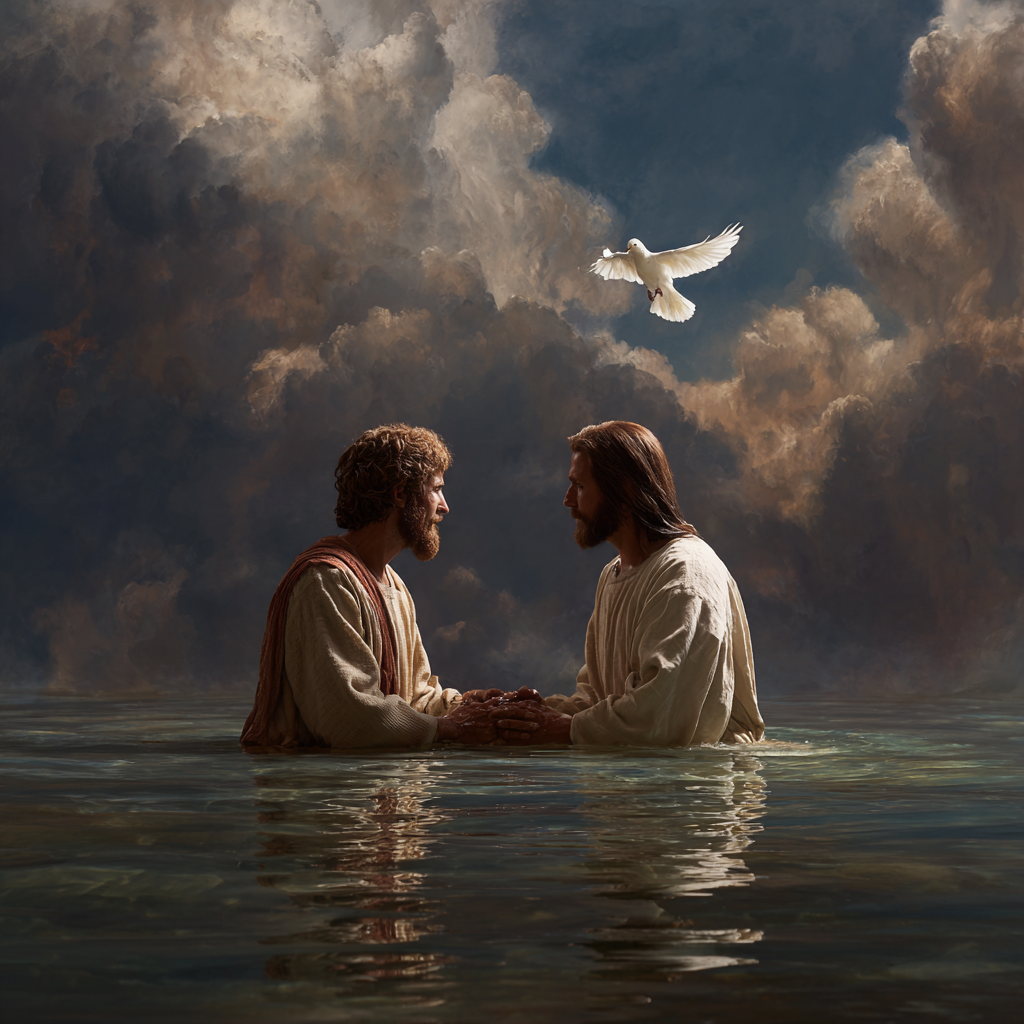
Jesus comes to John at the River Jordan, and asks to be baptized. John would have prevented him, saying, “I need to be baptized by you, and do you come to me?” But Jesus insists that all must be in order as told by the prophets. So John dunks Jesus, whom he recognizes as his Lord.
Just as Jesus comes up from the water, suddenly the heavens are opened to him and he sees the Spirit of God descending like a dove and alighting on him. And a voice from heaven says, “This is my Son, the Beloved, with whom I am well pleased.”
Isaiah tells Israel to expect this event: Here is my servant, whom I uphold, my chosen, in whom my soul delights; I have put my spirit upon him; he will bring forth justice to the nations.
Since the early Church, followers of Jesus have entered into baptismal waters and been blessed by the Holy Spirit. Even Isaiah spoke of the covenantal nature of baptism: I [the Lord] have called you in righteousness, I have taken you by the hand and kept you; I have given you as a covenant to the people, a light to the nations,7to open the eyes that are blind, to bring out the pri
soners from the dungeon, from the prison those who sit in darkness.
Perhaps the most notable change from the 1928 Book of Common Prayer and the 1979 Book of Common Prayer in present use, concerns the theology and use of baptism, the first great sacrament of the Church.
I grew up using the 1928 BCP, and was baptized at 18 months with the following words: We receive this Child into the congregation of Christ’s flock; and do sign her with the sign of the Cross, in token that hereafter she shall not be ashamed to confess the faith of Christ crucified, and manfully to fight under his banner, against sin, the world, and the devil; and to continue
Christ’s faithful soldier and servant unto her life’s end. Amen.
So you see, as a manful soldier of Christ, it was very hard for me to grow up imagining that I might someday be a womanly priest of Christ’s Church. Or for the Church to imagine women as priests.
In the old days, baptism was a doorway into the Church, or admission to Christ’s flock, which one would walk through with the completing sacrament of Confirmation at the age of twelve years or so. Only then would the baptized be permitted to receive the consecrated bread and wine of Holy Communion.
The powerful new theology of baptism grants the baptized full entry into the Church, the Body of Christ, with all the relevant rights and responsibilities. This means that a young child may receive Communion immediately after being baptized. Remember, when Jesus’ followers tried to keep little children from crowding in on him, Jesus rebuked them and said, “Suffer the little children to come unto me, and forbid them not: for of such is the kingdom of God.”
The power of baptism is also indicated in the setting of the Baptismal liturgy. During the use of the 1928 BCP, Morning Prayer was often said as the Sunday liturgy, with Holy Communion only conducted once a month. Typically, baptism was often done during Morning Prayer:
“…the Godfathers and Godmothers, and the People with the Children, must be ready at the
Font, either immediately after the Second Lesson at Morning or Evening Prayer, or at such other time as the Minister shall appoint.”
These days, baptism is almost always done as the first half of a service of Holy Communion, with the Sacrament of the Table immediately following the exchange of the Peace. The babies and little children come to the altar rail, and if they are old enough to eat and drink they are welcome to receive Communion as the newest members of Christ’s holy Church.
Another sign of baptism as full entry into the Church is the fact that almost never is baptism conducted any more as a private service. Presiding Bishop Frank Griswold, preaching at the ordination and consecration of a bishop at Washington National Cathedral, told the story of his own infant baptism. It was a social event as much as a religious one. Guests had been invited to the Griswold home early one evening. The baptism was conducted in the living room, with cocktails and congratulations immediately following. Nowadays, the only private baptisms are almost always in cases of emergency.
And perhaps the most important understanding of baptism according to our 1979 Book of Common Prayer, is that baptism represent a covenant between God and the baptized – just as Isaiah prophesied, that God has given his Son as a covenant to the people, a light to enlighten the nations. So important is this understanding, that the baptismal covenant is renewed on various occasions of worship on Sunday. In the case of the baptismal covenant, once is not enough – we revisit it frequently.
First come the renunciations of Satan and the evil powers of this world and all sinful desires that draw us from the love of God. Then follows the turning of the baptized to Jesus Christ, accepting him as our savior, putting all our trust in his grace and love.
These are the set-up for the Baptismal Covenant, beginning with the Apostles’ Creed. Then come with affirmations of intention to: proclaim by word and example the Good News of God in Jesus Christ, to seek and serve Christ in all persons loving our neighbor as ourselves, and to strive for justice and peace among all people and respect the dignify of every human being.
God’s part of the Baptismal Covenant is to bestow forgiveness of sin and raise us to new life in grace.
So, from Jesus’ baptism in the Jordan River by water and the Holy Spirit, we now have Holy Baptism as practiced by the Episcopal Church:
- Full entry into the Church, the Body of Christ
- Baptism as the first part of a liturgy of Holy Communion, not Morning Prayer
- Rarely as a private service
- Baptism as a covenant between God and the baptized
Recalling the baptism of our Lord Jesus Christ, let us rejoice in our own life as baptized members of the Church, the Body of Christ.
THANKS BE TO GOD. Amen.