God saves in history
SERMON PREACHED JULY 5, 2025, SIXTH SUNDAY AFTER PENTECOST, YEAR A
GENESIS 24:34-38, 42-49, 58-67; ROMANS 7:15-25a
From Genesis: And they blessed Rebekah and said to her, “May you, our sister, become thousands of myriads; may your offspring gain possession of the gates of their foes.”
I may have related this to you before, but I once had a clergy colleague, John Coleman, who was full in years and wisdom. When we were discussing holy Scripture one day, he explained that the whole Bible can be summarized in three words: God has intervened.
Think about it. From the creation narrative through the formation of the people of Israel, the people of the promise – which is the story in today’s lection from Genesis. Through the generations God accompanied and shaped God’s chosen people, providing the law and the prophets. Through the coming of the Son of God, born into history. He shaped it irrevocably, through his death and resurrection, for the salvation of all humankind. Through the formation of the Church universal on the day of Pentecost. Through the apostolic era and the time of the Church fathers. Down through the millennia until the present time. This whole stream of events has been God intervening, and still God is intervening.
Now, today’s text from Genesis tells of Abraham’s servant carrying out a promise he had sworn to his master, that he would find and fetch a bride for Abraham’s only son, Isaac. The stipulation is that the bride must not be a Canaanite, but a woman of Abraham’s own people.
Abraham’s servant has the unenviable task of being a matchmaker. How in the world is he going to locate and identify a non-Canaanite woman willing to move to Isaac’s people and marry Isaac? These days, people turn to dating websites. One of my daughters, Elizabeth, met Dan that way and they married – that marriage is beautiful and has lasted. They have two children, Sage, 12 years old, and Roman, 11.
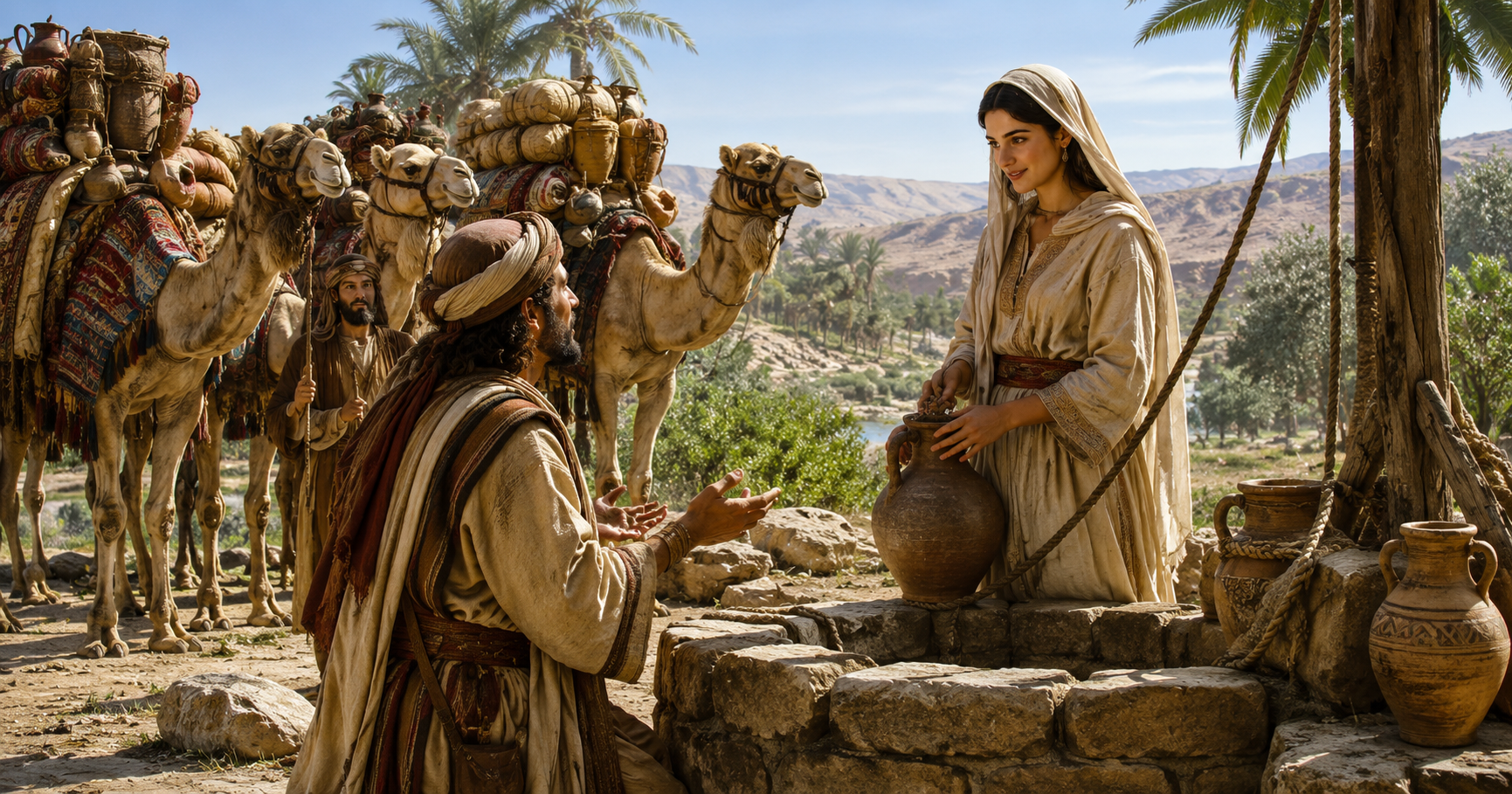
Or someone in our day may look for a match by relying on friends, or business colleagues, or people in affinity groups like clubs or volunteer organizations. Or church! In the case of Abraham’s servant, he stops by a well with his camels, loaded with provisions and gifts. This is a busy place, as everyone in that community draws water from that well.
He prays in his heart, ‘Let the young woman who comes out to draw, to whom I shall say, “Please give me a little water from your jar to drink,” and who will say to me, “Drink, and I will draw for your camels also” —let her be the woman whom the Lord has appointed for my master’s son.’
What is your experience of God answering your prayer? We talked about many such things in our book study group, and pretty much everyone has a story of answered prayer. God listens to us every minute of every day, and gives us blessings. God fills our lives with bounty in many ways. If you can’t think of such a time, of answered prayer, or blessings filling your life without even asking, I suggest that you practice turning your heart to God. The eyes of your heart will begin to notice. God never fails.
In the case of Abraham’s servant – who deserves a name, in my opinion, but he is only a servant, so his name is not recorded – his prayer is answered by a young woman named Rebekah. The dialogue proceeds just as he had wished. And she consents to go with him to the tent of Isaac’s mother, Sarah. And Isaac takes her to wife. And he loves her.
From Jacob, named Israel – one of the two sons of Isaac and Rebekah – come twelve sons. Each becomes the patriarch of a tribe: Reuben, Simeon, Levi, Judah, Dan, Naphtali, Gad, Asher, Issachar, Zebulun, Joseph and Benjamin. These are the twelve tribes of Israel, the people whom God chooses to live with in covenant. Jesus is descended from Judah.
One reason I like this account in Genesis, is its historical and social detail. The servant swears to his father by placing his hand under his father’s thigh. Then when Rebekah says she will go with the servant, he places bracelets on her arms and a ring in her nose. Something like an engagement ring or our day. Then the servant inquires of Rebekah whether she will consent to go with him to his master’s house.
There is a place in our Episcopal marriage rite called the Declaration of Consent. This is left from the days when sometimes a woman would be forced into marriage. Even in our times, not just the woman but both parties must consent to the marriage. And, another historical-social detail: when Rebekah discovers that the man walking toward her is the servant’s master, she covers herself with a veil – very much like some practices today in the mid-East.
So in the narrative of Rebekah and Isaac, we see God intervening in history, accommodating the habits and ways of the people of the desert. In this fashion, God exhibits faithfulness across generations, continues the Abrahamic covenant, shows that God chooses and calls, and initiates the emergence of Israel as a nation.
Then, two thousand years later, the apostle Paul calls us to recognize the ultimate way in which God intervenes in history. He puzzles over the fact that he is not spiritually strong enough to resist sin, even though he knows very well what he should do or not do. Paul exclaims, “Wretched man that I am! Who will rescue me from this body of death?”
He is not alone. Every person who ever walked this earth is prey to Satan – is fallible, unable to hold out against doing the wrong that we know we should not do. This brings us squarely to our baptismal covenant, when we renounce: Satan and all the spiritual forces of wickedness that rebel against God. The evil powers of this world which corrupt and destroy the creatures of God. And – in company with Saint Paul – renounce all sinful desires that draw us from the love of God.
We promise, but none of us is strong enough alone to resist. Paul, knowing this, exclaims:
“Thanks be to God through Jesus Christ our Lord!” For it is Jesus’ own powerful and ultimate sacrifice on the cross, who rescues us from our bodies of death. This is the pivotal intervention by God in the world.
Yet, we must continually repent of our sins. Satan leaves no one alone. This is why we pray in the General Confession: Most merciful God, we confess that we have sinned against you in thought, word, and deed, by what we have done, and by what we have left undone.
We are in this situation not because Jesus’ salvation is ineffective, but because Jesus is the only sinless being. Because we cannot make it through a day without offending God in some way or other. This is why we daily pray the Lord’s Prayer: Our Father, forgive us our trespasses, as we forgive those who trespass against us… and deliver us from Evil.
For Thine is the Kingdom and the power and the glory, forever and ever.
THANKS BE TO GOD. Amen.