God’s new call
SERMON AUGUST 30, 2026, THE FOURTEENTH SUNDAY AFTER PENTECOST
EXODUS 3:1-15
From the Old Testament: Remove the sandals from your feet, for the place on which you are standing is holy ground.
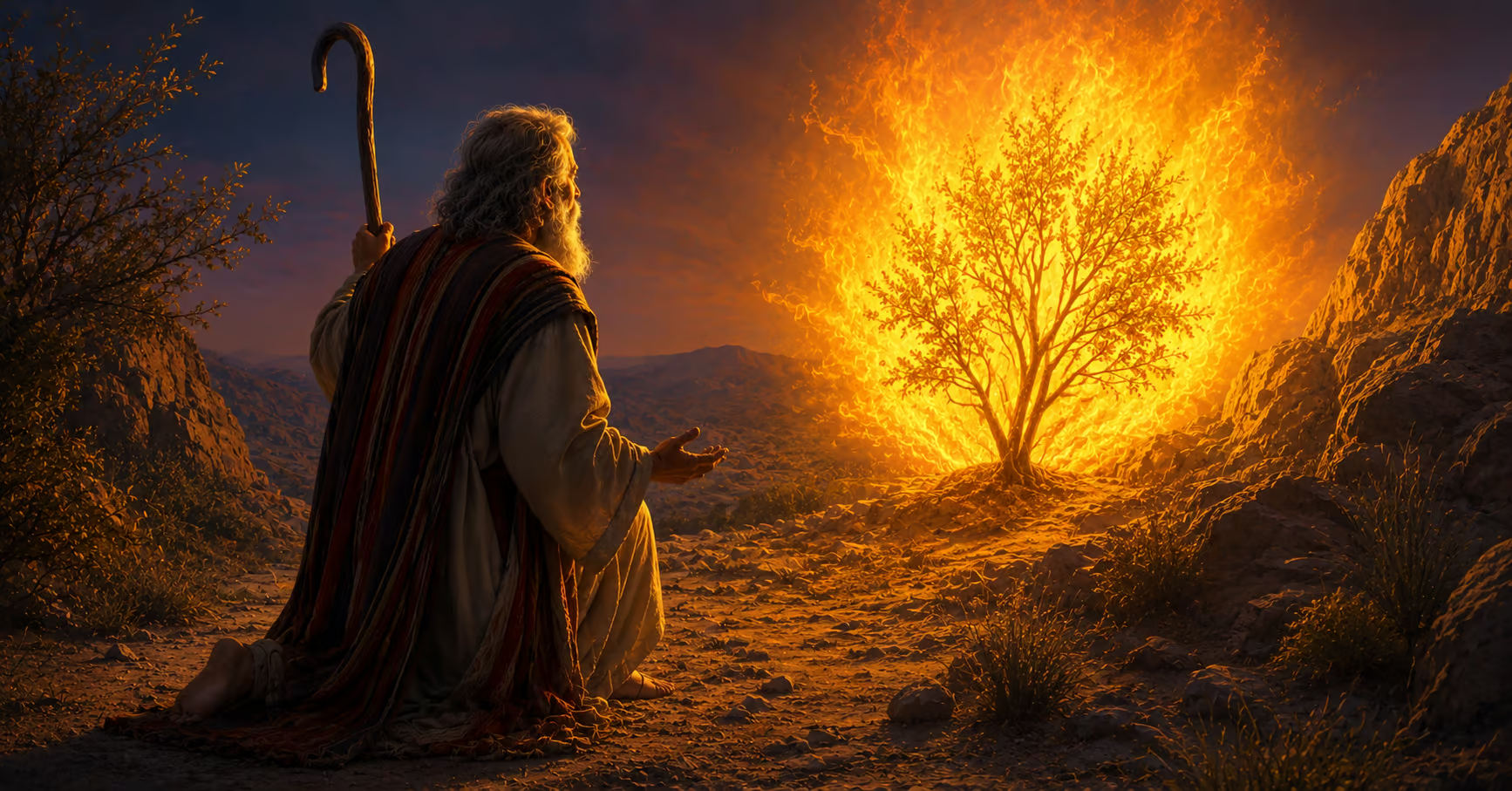
God showed Moses a phenomenon, unique in nature: a bush that is aflame, yet withstands the fire and neither chars nor turns to ash. This divine revelation stands among the most hallowed known in Scripture, and few others can match it. This is God’s way of attracting the attention of Moses, the sheepherder. As a man who spends his life caring for a flock of animals in the grazing lands of Midian, Moses is a scholar of nature. He knows which plants are good for grazing, and which should be avoided. He knows where to find streams and springs of water. Birds and other wild creatures and insects are familiar to him. He has favorite places to bed down for the night, sheltered from the elements. This man definitely would go out of his way to inspect a burning bush that was not consumed by fire.
We in our own way are scholars of our life setting. Here, All Saints people know the beach, and the sky and sand. We – I’m counting myself as one of you! – know what the ocean looks like when a storm is brewing. We can read the broad sky and clouds, here with no skyline to hem it in. We have our favorite places to go shelling, and picnicking and wave surfing. We delight in the sight of dolphins playing, and the gleam of sunrise harkening a new day.
I have learned that there is a new entry in the Revised Common Lectionary. This is the list of Scriptural lections from which we and other like-minded churches draw readings for Sundays and other days. The new entry is available to the Episcopal Church and is called Creation Sunday. It is to be observed on the First of September or the nearest Sunday after that – this year that will be next Sunday. We can look to this new feast day to inspire us to care for the gift of the created world. Creation care, that is called. Although the Church of England and the Anglican Church of Canada have adopted Creation Sunday, the Episcopal church has yet to do so.
Grounded in an ancient liturgical tradition of the Eastern Orthodox Church, this is a day to praise God as Creator and ponder the great mystery that everything was created through Christ. Remember the Gospel according to John:
1 In the beginning was the Word, and the Word was with God, and the Word was God. 2 He was in the beginning with God. 3 All things came into being through him, and without him not one thing came into being. What has come into being 4 in him was life, and the life was the light of all people.
This newly-available season would allow us to consider the range of Creation Care: (1) Creation as God’s creative act, (2) Creation as a mystery of Jesus the Son of God, (3) Creation as a mystery of the Holy Trinity and (4) Creation as a sacrament and covenant with God.
Now let us return to Moses and his father-in-law’s, Jethro’s, flock. God tells him that where he stands is holy ground. He is near the burning bush, and near Mount Horeb, the holy Mountain of God. Moses’ story later circles back to Mount Horeb, as God says would happen, which is also where God delivers to him the tablets of stone bearing the Ten Commandments.
What makes a place holy? It may have been blessed specifically, or more likely it may be holy because of the people who made it so. I maintain that all of Creation is holy, made by God and called “good.” So wherever humans stand or walk or crawl or sit or sleep is holy, is good. Our wild places and parks count for this, as does the earth holding our homes, and neighborhoods and places of commerce and learning and social gathering. When viewed this way, we should remove our shoes for every step we take.
God, speaking to Moses, gives him a call: He calls Moses to leave Jethro’s flock. He is to go to the Israelites in Egypt where they are enslaved, and bring them out of slavery. In God’s own time, this is the moment when God responds to the misery and cries of God’s people, and determines to release them. Determines to dry their tears and soothe their physical and emotional hurts. Now, God determines to free them from oppression. And Moses is the man to do it.
He will lead the Israelites to a good and broad land, a land flowing with milk and honey, to the country of the Canaanites, the Hittites, the Amorites, the Perizzites, the Hivites, and the Jebusites. Remember, Moses was once a baby boy, born of enslaved Israelites in Egypt, and at risk of being killed: Because Pharoah felt threatened by the burgeoning population of the Israelites, he decreed that every boy of theirs was to be killed at birth. Moses is hidden from harm through subterfuge and taken into Pharoah’s own household.
One day the adult Moses goes into town and sees an Egyptian beating an Israelite, one of Moses’ own people. In anger at the injustice, Moses kills the Egyptian and flees the country. In due course he settles in Midian, marrying Zipporah, daughter of Jethro.
So God is now calling Moses to return to his own people and lead them to safety. Moses is stunned and questions God. Says he is just an ordinary man. But the reply is that God will be with Moses all the way. Though not in our reading today, Moses argues further with God and says he doesn’t know how to speak in public. God has an answer for that, too, saying that Moses’ brother, Aaron, will speak for him.
When has God called, nudged, urged you to do something? And was it something definitive, something that would take you down a new path, crossing a threshold in your faith journey? I think it likely that God has worked in all of your lives this way, even to a small extent. Every day, God is drawing you closer, waiting for you and enabling you in love.
As common as this is, not everyone responds the way Simon and Andrew, James and John did, dropping everything and following Jesus. Many people object, argue with God. Why me? I can’t do what you say. It will cost too much –in dollars or in other losses. How did you respond, when God called you to change direction, to overcome a barrier, to jump to your own two feet and follow Jesus? If you didn’t say yes right away, you are in good company, Moses being a prime example of a naysayer – and one who was persuaded by God.
Then Moses says the people will not follow him unless they know who is the God that will protect them. Now, bear in mind that over the ages God has been working with Abraham and Isaac and Jacob and all their offspring, to gather to himself a people who will be his especially. This is preparing the way for the messiah in later times to be born into their midst and recognized and followed. So God reminds them that God is the God of Israelite ancestors, and they know this God.
But the most provoking and eye-opening name that God offers, continuing to speak from out of the blazing flame, is I AM. This makes no sense in English, but in Hebrew it expresses all states of being, past, present and future. This is God, the Creator, who was and is and is to come. Who contains all sense and power of being. This is the God who will accompany Moses and lead God’s people out of slavery.
This, too, is our God, the great I AM, who is beyond all thought and time and place. Yet this God is as close as your ear, and eye, and heart and soul and mind. This God lives within us, and we in Him. Approach the great I AM in prayer this morning, and in the Holy Eucharist, with a glad and grateful heart. Listen for God’s call and be ready to say yes.
THANKS BE TO GOD. Amen.