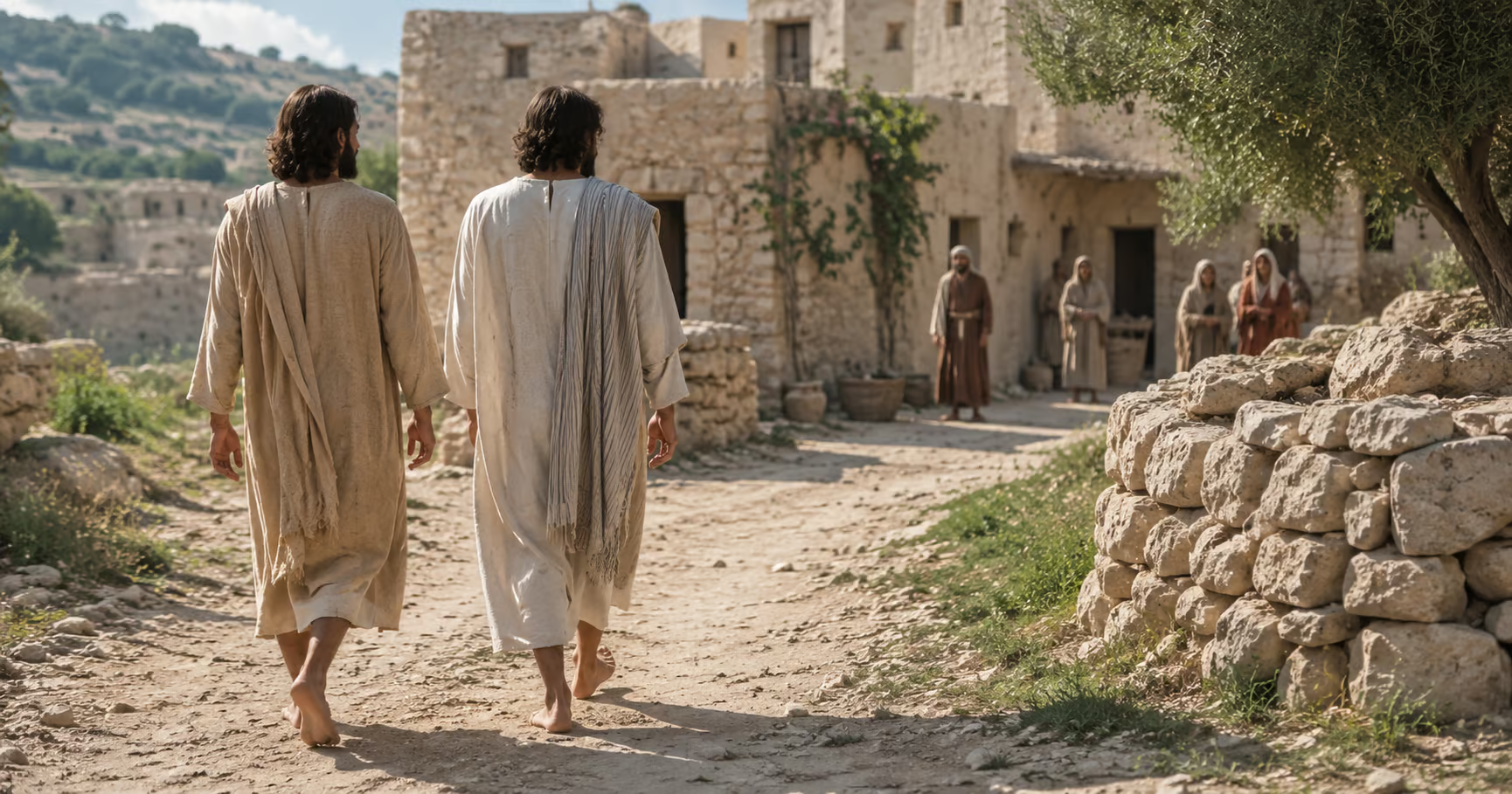
Take no bag for your journey
SERMON JUNE 14, 2026, THIRD SUNDAY AFTER PENTECOST, YEAR A
PSALM 116:1,10-17, MATTHEW 9:35-10:8,(9-23)
From the Gospel: Take no gold, or silver, or copper in your belts, no bag for your journey, or two tunics, or sandals, or a staff; for laborers deserve their food.
These are the early days of Jesus’ ministry. To begin with, Matthew names the twelve disciples: first, Simon, also known as Peter, and his brother Andrew; James son of Zebedee, and his brother John; Philip and Bartholomew; Thomas and Matthew the tax collector; James son of Alphaeus, and Thaddaeus; Simon the Cananaean, and Judas Iscariot, the one who betrayed him.
That was then – yet both the model and the instructions are telling for us now, as followers of Jesus Christ. This is before the Church existed. There are no walls, no seats, no taking in and spending to support the Kingdom project. Jesus sends his disciples to the “lost sheep of Israel.” The work is to refresh the Israelites, to teach and to heal them, individually and in community as they are settled, in towns and villages. Throughout Galilee and the land of the Jordan River the disciples disperse to proclaim that the Kingdom of God has come near.
I hail from the Diocese of Virginia, where the people are taught to “Love Jesus. Embody Justice. Be Disciples.” Discipleship is still our call today, even though the setting and requirements are wildly different. Would Jesus tell us to take neither our cars, nor our cell phones? First century Israel traveled on foot, or by donkey. Twenty-first century America travels by automobile or by public transportation where it exists. That’s how we reach the folks who need to see and hear us proclaim the Kingdom of God in word and deed.
Not only that, but now we have church buildings to gather in for worship, and assets to support our work of discipleship – and our work of loving Jesus and embodying justice. In those days, Jesus and his disciples gathered with people in houses and synagogues, in village centers, and in open fields along highways and byways. But Jesus’ first-century ministry was itinerant. He had no home, except in Nazareth. He made Capernaum a much-frequented location, where he stayed in Peter’s house.
Jesus’ insistence on depending for sustenance on the disciples’ hosts placed a burden on the ministry. At the same time it opened the way for spiritual growth. Not only were they to eat whatever was offered to them, but they were to carry no backpack with extra clothing or supplies. In the simplest terms, they were to travel barefoot, and without a walking staff to take \ weight off a weary back.
Our beloved Saint Francis of Assisi is someone to study in this context. So dedicated was he to imitating the life of Christ that he founded the Franciscans as a mendicant – or begging – order.
The time for such an enterprise, around the year 1209, was right. Growing towns, expanding trade, and widening gaps between rich and poor created both prosperity and spiritual unease. Many Christians longed for a simpler, more apostolic form of life modeled directly on Jesus and the disciples.
Francis himself was born into a prosperous merchant family in Assisi. As a young man he enjoyed the life of a rising middle-class youth: fine clothing, parties, dreams of knighthood, and social prestige. But after experiences of illness, war, imprisonment, and an increasingly intense spiritual awakening, he underwent a dramatic conversion.
A turning point came when Francis heard the very passage from Matthew’s Gospel that we listened to this morning. Francis was so impacted by Jesus’ design for living that he experienced a spiritual awakening: Francis became convinced that Christ was calling him to live literally in poverty – which meant dependence upon God. He rejected his father’s wealth, gave away money and possessions, cared for lepers, repaired ruined churches, and embraced what he called “Lady Poverty.”
Tellingly, Francis did not retreat into a monastery. Traditional monks such as the Order of Saint Benedict lived in stable communities behind monastery walls, supported by land and property. Francis instead set up a radically different way of life for his followers.
Francis believed that wealth and institutional power could spiritually corrupt the Church if Christians lost sight of humility and dependence on God. The Franciscan movement embraced a combination of joy, brotherhood, service to the poor, and radical simplicity. Young men were drawn to this new way of living, and the movement grew astonishingly fast.
Today there are both Roman Catholic Franciscans and Anglican/Episcopal Franciscans, along with smaller Lutheran and ecumenical Franciscan communities. The Franciscan spirit — simplicity, prayer, care for the poor, peace-making, and reverence for creation — has actually gained renewed relevance in modern times. The wealth gap and consumerism cry out for the Franciscan way of life. Francis’ famous “Canticle of the Creatures” resonates deeply in an age concerned about climate change and ecological damage. Many Franciscan communities now explicitly connect spirituality with environmental activism and sustainable living.
Not all Franciscans live in community. Third Order Franciscans are ordinary layfolk conducting their lives in accord with Franciscan tenets. They may be married or single, clergy or non-clergy, professionals, teachers, social workers, artists, retirees or students. They live at home, support themselves financially, and commit to a personal Rule of Life centered on prayer, simplicity, study, and service.
Twenty-first century Franciscans are known for ministries expressing love for Jesus through:
- spiritual direction and retreats
- care for the poor and unhoused
- environmental stewardship
- reconciliation and peace work
- contemplative prayer
- hospital and hospice chaplaincy
- ecological theology and “creation care.”
I want to tell you, that as I prepared this sermon a penniless Black man named Curtis Lee, trying to get back home to South Carolina, stopped by the Church. He had nothing with him for his journey. He needed gas and food, so I emptied my wallet, to the tune of $40 – not very much, but it was all I had. Plus a couple of energy bars.
I am skeptical of coincidences. I believe that Mr. Lee was drawn by the Holy Spirit to St. Francis’ Church—and how exactly did he find us, out of the way in the forest? – in his time of need. And he came to put flesh and bones on the Gospel. He was a child of God, on his way home. In the name of St. Francis I blessed him, and in so doing I was blessed, St. Francis Church was blessed.
Not only that, but Mr. Lee could be seen as one of Jesus’ disciples, going about from place to place, hoping for somewhere he would be received with hospitality. In that case, Mr. Lee brought the Gospel to me, the priest at St. Francis Church. Would St. Francis ask him to come in, to have an exchange about giving and receiving? Who was the giver in this case? Yes, I gave Mr. Lee cash and food. But he gave me the Good News, didn’t he? That the Kingdom of God has come near. God is full of grace and wonders.
THANKS BE TO GOD. Amen.