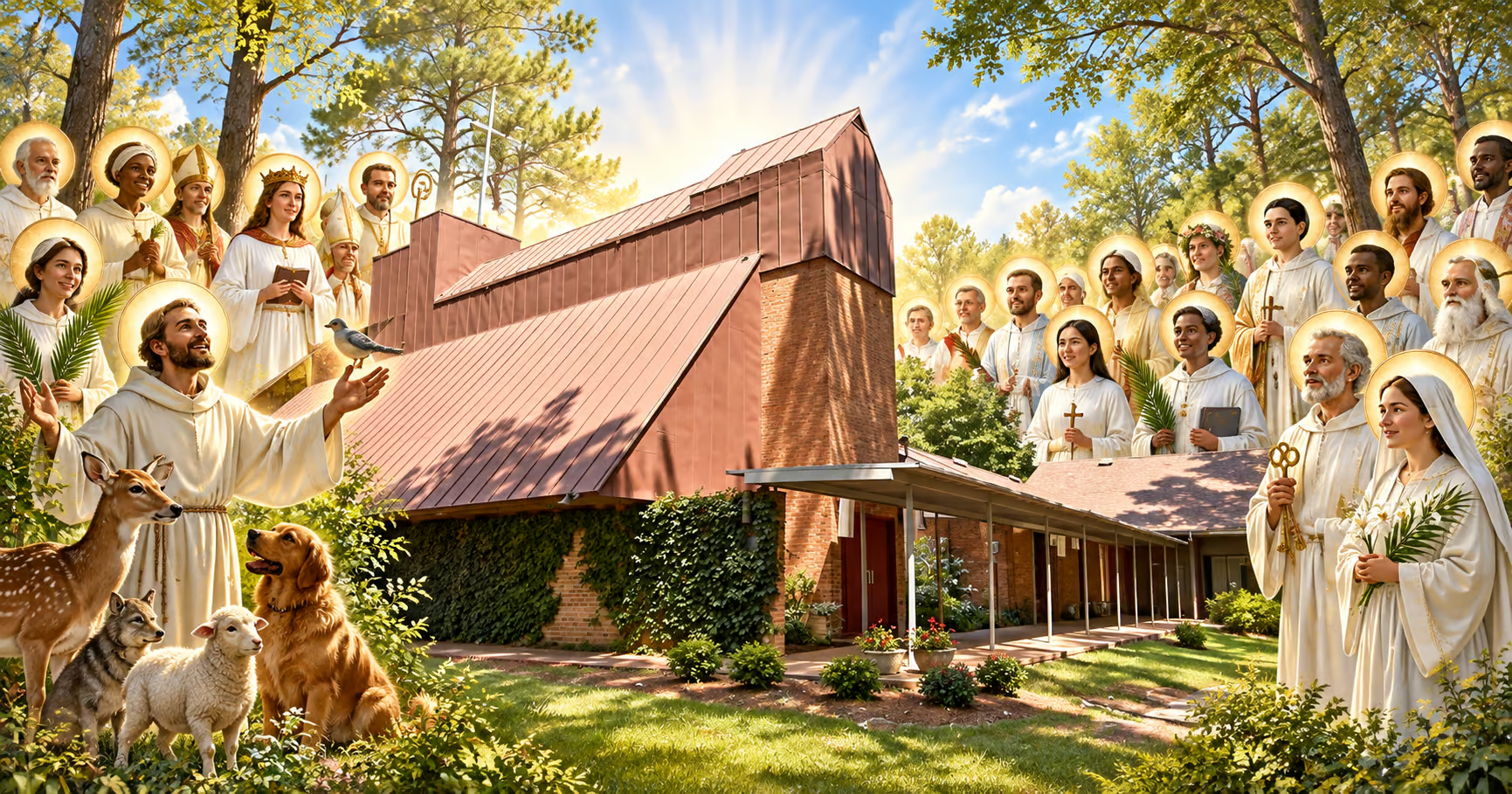
We have company
SERMON NOVEMBER 1, 2026 – ALL SAINTS’ DAY
REVELATION 7:9-17; PSALM 34:1-10, 22; 1 JOHN 3:1-3
From the Psalm: Taste and see that the Lord is good; *
happy are they who trust in him!
We have company! The doorbell rings, and look who’s there. On this All Saints’ Day, one of the major feast days of the Church, we look around us and discover anew a multitude of faces and bodies, all shining and dancing and singing with joy. We accompany this sight with the bells of our amazing tintinnabulum – which formed part of our precession this morning. These whom we see are the saints of God: each person who ever lived by faith, each person who is saved by our Redeemer. They are knit by grace into one communion and fellowship in the mystical body of the Christ.
And we, too, are numbered among them. We are living saints of God, forgiven and free, born to enjoy the glory of the Lord and to serve him.
A few weeks ago, our beloved brother, Al Elmore, crossed over that decisive line between the living and the dead. And though we continue to grieve, we are grateful that his sufferings have been lifted. He dwells in the nearer presence of God, revived as his best self forever. Earlier this year, we buried Stephen LaRoche’s father, Richard, in our columbarium. He, too, our friend, is released from his sufferings, and transported into the nearer presence of God, there to dwell as his best self forever.
In the Revelation to St. John, the apostle is privileged to see some of this mystery. John is overwhelmed. He gazes into heaven and sees a great multitude that no one can count, from every nation, from all tribes and peoples and languages, standing before the throne and before the Lamb, robed in white, with palm branches in their hands. They cry out in a loud voice, saying,
“Salvation belongs to our God who is seated on the throne and to the Lamb!
Remember the parable we recently heard from Matthew’s Gospel, the parable of the wedding feast? To fill the hall, the king sent his servants out into the streets to bring in everyone they found. God is the king, filling his banquet hall, populating his Kingdom, with a multitude from every nation, from all tribes and peoples and languages. Al is among them, Richard is among them. We, too, will be among them. Having come out of the great ordeal, washing our robes white in the blood of the Lamb, worshiping at the throne of God and of the Son.
Worship is the kind of thing we do in our lives, praising and giving thanks to God. Worship is also every act of service we perform, for our brothers and sisters. Jesus describes the Kingdom of God as being full of blesseds: the poor, those that mourn, the meek, those that hunger and thirst after righteousness, the merciful, the pure in heart, the peacemakers, those that are persecuted for righteousness sake, those that are reviled and have evil cast against them for Jesus’ sake. In other words, our work in heaven is not limited to speech and music and dance – it is full of the things that make the Kingdom of God, realized on earth as in heaven, joyous.
Every Christian is called into holiness through the grace of God, and every faithful Christian belongs to the communion of saints. We are saints, each one of us. Some saints become famous. Most do not. Some, such as Francis of Assisi, are remembered in church calendars. Others are remembered only by their families, friends, and congregations. And countless others are remembered by God alone.
How do we keep our ties to the saints of God strong? It is through prayer. We remember in prayer our family and friends whom we see no more, but who are with us on a farther shore.
We also keep our ties to the saints of God strong through stories. For our family and friends, we keep them alive in our hearts by remembering how they lived. Little things, big things. Take, for example, my father, Commander George Randolph Cooper, Jr., who was a very young Naval officer in World War II, only twenty years old. He commanded a landing craft, a LCI, during the invasion of Southern France. This “Operation Dragoon,” which took place in August 1944, was a bookend to the invasion of Normandy but much less celebrated.
Now, a landing craft is a flat-bottomed vessel drawing only 3-5 feet. It would not be considered seaworthy under normal circumstances. But after Operation Dragoon was done, the Navy sent my father and his LCI home to Little Creek, Virginia, across the wide Atlantic.
A storm blew up, and my father was topside without a lifeline. Waves crashed over the deck and swept him aft. He held on to the gunnel with just his fingertips. If he hadn’t managed to clamber aboard, I wouldn’t be here today. Not only was this harrowing, but the LCI had no proper navigating equipment. He had to find its way across the ocean by dead reckoning. This is a way of calculating the current position of a moving object by using a previously determined position, and incorporating estimates of speed, heading and elapsed time. It is subject to miscalculation because of winds and current. My dad’s navigator probably used simple instruments, such as a chart, dividers, a protractor, a ruler and basic arithmetic. No celestial sighting. The result was commendable, as they landed in Virginia only about 20 miles from Little Creek.
Why have I taken the time to tell this story? Because these saints of God, including George, are remembered by our family, only. No friends know this story. I know that you have similar stories about the saints in your family. I will tell them to my children, as you will tell them to your children. And we will see them again in heaven.
Now let me tell a story about Francis, our patron saint, whom the Church the world over remembers. Francis, the son of a cloth merchant, longed as a young man to join the knightly class. He dressed like a nobleman, he gave alms generously like a nobleman. And he fought in battles between city states in Italy, and between partisans in other wars. It happens that Francis had a dream, which seemed to confirm his intention. In the dream he saw his whole house full of military dress and weapons – things definitely lacking in his actual home.
But it turned out that God had other plans for Francis. The dream needed to interpreted another way. Jacques Le Goff in his biography of Francis describes the change this way:
To his new life, Francis would bring the passions of his youth: poetry and the taste for joy that, from being profane, would become mystical; the generosity that would consist in pouring out not money but words, physical and moral fortitude, all of himself unreservedly; the militant ardor that would enable him to endure every trial and to initiate the assault on all the fortresses standing in the way of his brothers’ salvation…and sin in all its forms.”[1]
St. John the Evangelist looks upon all the saints, and is very clear about our status:
See what love the Father has given us, that we should be called children of God, and that is what we are. The reason the world does not know us is that it did not know him. 2 Beloved, we are God’s children now; what we will be has not yet been revealed. What we do know is this: when he is revealed, we will be like him, for we will see him as he is. 3 And all who have this hope in him purify themselves, just as he is pure.
This All Saints Day we regale God with our prayers of praise and thanksgiving, for all the saints, known and unknown, who fill the heavens. And for all the saints here on earth, and all the saints yet to be born. As St. Francis Church follows the way of Jesus, we have company!
Taste and see that the Lord is good; *
happy are they who trust in him!
THANKS BE TO GOD. Amen.
[1] Le Goff, Jacques, page 27