The promises of God
SERMON OCTOBER 29, 2026 – TWENTY-SECOND SUNDAY AFTER PENTECOST
- THOMAS EPISCOPAL CHURCH, ORIENTAL
THE COLLECT; PSALM 90:1-6, 13-17; DEUTERONOMY 34:1-12
From The Collect: that we may obtain what you promise, make us love what you command
According to Scripture, Moses was 120 years old when he completed his work for God. For the last forty of those years he led the fractious Israelites through the wilderness, relying only on God’s promise and faith to hold them together.
Remember God’s promise to Abraham: “Go from your country and your kindred and your father’s house to the land that I will show you. 2 I will make of you a great nation, and I will bless you and make your name great, so that you will be a blessing. 3 I will bless those who bless you, and the one who curses you I will curse, and in you all the families of the earth shall be blessed.” [Gen 12:1-3]
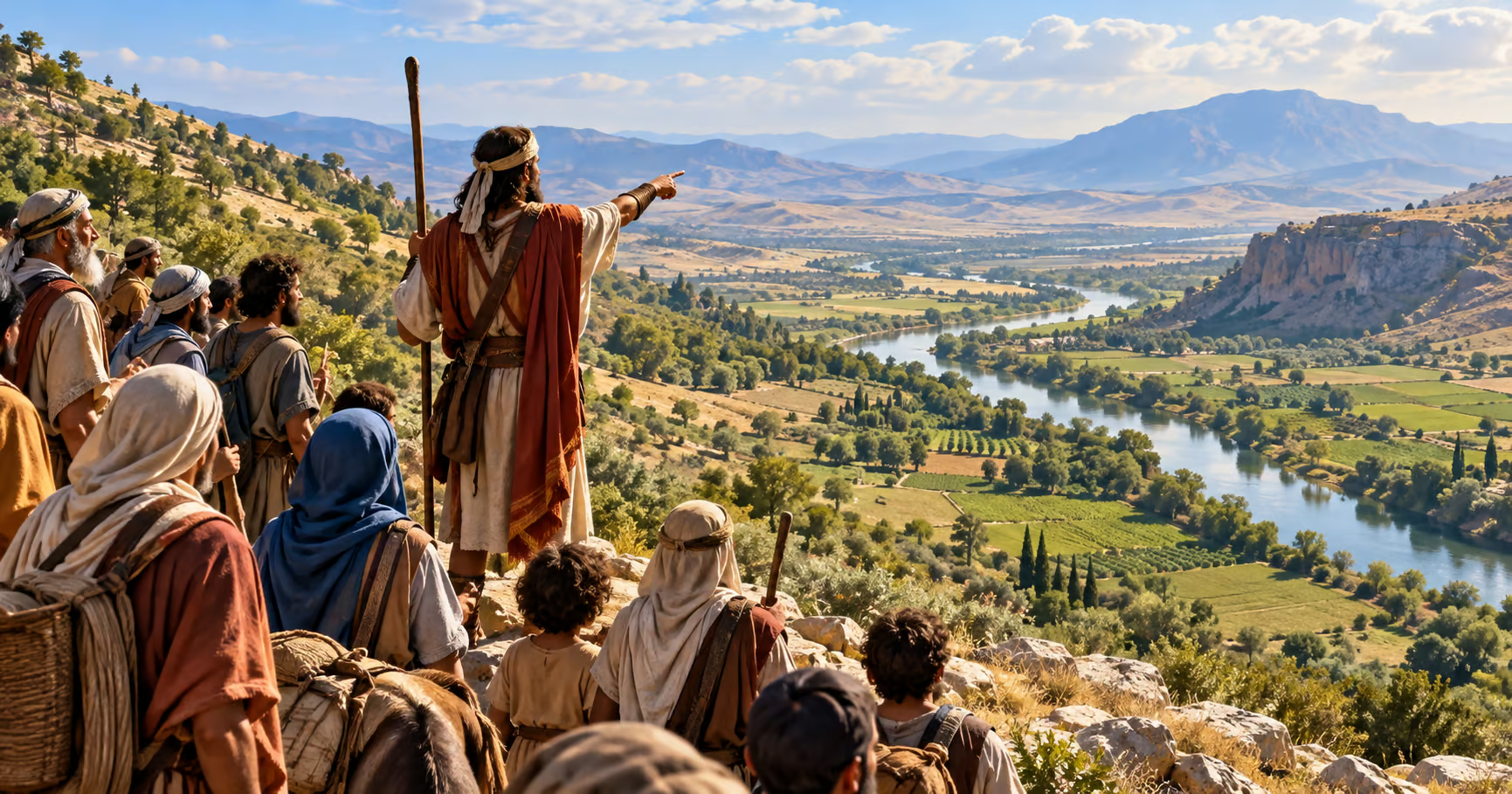
Then, before sending Moses to lead the Israelites out of enslavement in Egypt, God shows Abraham the land of the Canaanites, and says, “To your offspring I will give this land.” [Gen 12:7] So Isaac and Jacob are to inherit this broad territory, the “Promised Land.”
Now, in a second act, the Israelites cross over the River Jordan. This happens by a miracle that enables them to tread across with dry feet. Of course this parallels the crossing of the Red Sea so many years earlier, Moses’ signature miracle. Now God performs a signature miracle for Joshua. As with Moses, this event establishes Joshua’s preeminence, and the people readily follow him.
We will pause for a moment to consider the fact that this land was inhabited by the Canaanites, who were of no mind to step aside for invading Israelites. During the conquest of Canaan, so great was the conflict that a total of thirty-one kings were brought down by Joshua and his army. In each battle, Israel won when they obeyed God – and lost when they did not. God’s promise of land meant war – an inevitability in our fallen Creation. It may be hard to accept this, because paradoxically this happened in a Creation ruled by the Prince of Peace.
Remember, Jesus in Matthew’s Beatitudes says that peacemakers will be blessed, and he promises that they will be called children of God. But peacemaking comes at a price. Apparently, for the Israelites God’s promised land is not a gift wrapped neatly in a bow, but one that must be wrested from opposing powers. How then is Israel to track the difficult terrain between peace and conflict, seeking God’s promises?
From this inherent age-old conflict arises much of the disharmony that exists in the Holy Land today. Some of what occurred during the original Israelite invasion was peaceful assimilation, as intermarriage between the Israelites and the Canaanites took place. But harmony is not and has not been the state of things in the Holy Land since way before the creation of the nation of Israel.
The 1947-48 Arab-Israeli War resulted in the expulsion and flight of Arabs from the new state of Israel, established in 1948. This event subsequently led to waves of Jewish immigration from other parts of the Middle East and Europe, into Israel. In modern times, this is how the land promised by God to the Israelites was seized and occupied.
This morning’s Collect, the prayer that gathers together all the scripture for the day, asks “that we may obtain what you promise, make us love what you command.” That’s where Joshua’s Israelites stand. On the verge of entering into the promise, the one thing needed is that they love what God commands. Difficult days lie ahead, and faithful love is the necessary fortification.
Now let’s turn to St. Thomas, on a journey led by the Holy Spirit, guided by your our bishop and your vestry and faithful parishioners. You are not, like Joshua, in the business of unseating mortal enemies. You are, however, traveling through challenging times. As the Priest-in-Charge at St. Francis, Goldsboro, I know well the promises of God and the struggles to reach for God’s gifts. I can attest to the fact that the only way through is to love what God commands.
Over the past ten years, three different priests have led St. Francis, not counting long periods of service by interims and supply priests. You have had significantly greater stability, but I know that still the periods of wandering between priests are anxiety-provoking. The only way through, reaching for God’s promises, is to love what God commands.
The first challenge, then, is to clarify God’s commands for St. Thomas. Jesus’ overarching commands are to love God, and love your neighbor as yourself. You are a parish blessed with a joyous and vigorous sense of mission and ministry. The Holy Spirit is alive here! You find joy in loving your neighbor: “The Outreach Committee’s vision is to offer the St. Thomas community opportunities to realize joyful giving experiences while providing responsible stewardship of church resources.”
I note the full list of organizations that are recipients of St. Thomas’s funds. Among these are Oriental’s Children’s Theater Workshop, and Episcopal Relief and Development – a blessed outreach of the Episcopal Church to those in need. I served at ERD for a time, working in Ethiopia, South Africa and Haiti. As an example of what ERD does, our work in Haiti was to purchase land for a school educating grades kindergarten through 12, develop blueprints for the building, teach the local priest project management, make recommendations to the bishop on a modern curriculum and teacher education, and erect the school building along with a building for a new technical school for adults.
The Rt. Rev. Jean-Zaché Duracin was at that time the Bishop of Haiti, a missionary diocese of the Episcopal Church – meaning that it is not financially self-sufficient. The Diocese of Haiti now is struggling to call a new bishop, and is going through its own wilderness years. It is one of the largest dioceses in the Episcopal Church and counts about 100,000 members. I ask that we spare a prayer for our sister diocese of Haiti in its own journey into God’s promises.
The bounty of St. Thomas’ outreach funding is certainly loving your neighbor. However, this may be a matter of signing checks, which is a good but incomplete response to Jesus’ command. In addition, you are personally engaged in neighborly ministries including feeding, academic scholarships and reading programs, assisting those in need from youth to hospice, and taking care of animals needing food and medical treatment and homes. Whew! St. Thomas is putting a smile on Jesus’ face.
I like to ask the question: if St. Thomas were to disappear overnight, who would care? Obviously, you have knit yourselves into the fabric of the community of Oriental and further afield so that many, many people would seriously miss you and your ministry. I dare say, if this were to happen, St. Thomas people would also miss the work of ministry.
In putting your hands and hearts and minds to use, and in stewarding your funds, St. Thomas is reaching out for God’s promises. Not lands in this case, but promises of a new life in Christ in this place. What will these new promises look like? Slowly, or perhaps with a stroke of holy insight, as you seek your next rector, and your next rector seeks you, the promises of God for St. Thomas will become evident. And they will usher in something new, something that gives rise to holy joy. Something that increases your faith as you journey onward.
So with the psalmist this morning we recognize the greatness of God, and we pray:
1Lord, you have been our refuge *
from one generation to another
.2 Before the mountains were brought forth,
or the land and the earth were born, *
from age to age you are God…
16Show your servants your works *
and your splendor to their children.
17 May the graciousness of the Lord our God be upon us; *
prosper the work of our hands;
prosper our handiwork.
THANKS BE TO GOD. Amen.