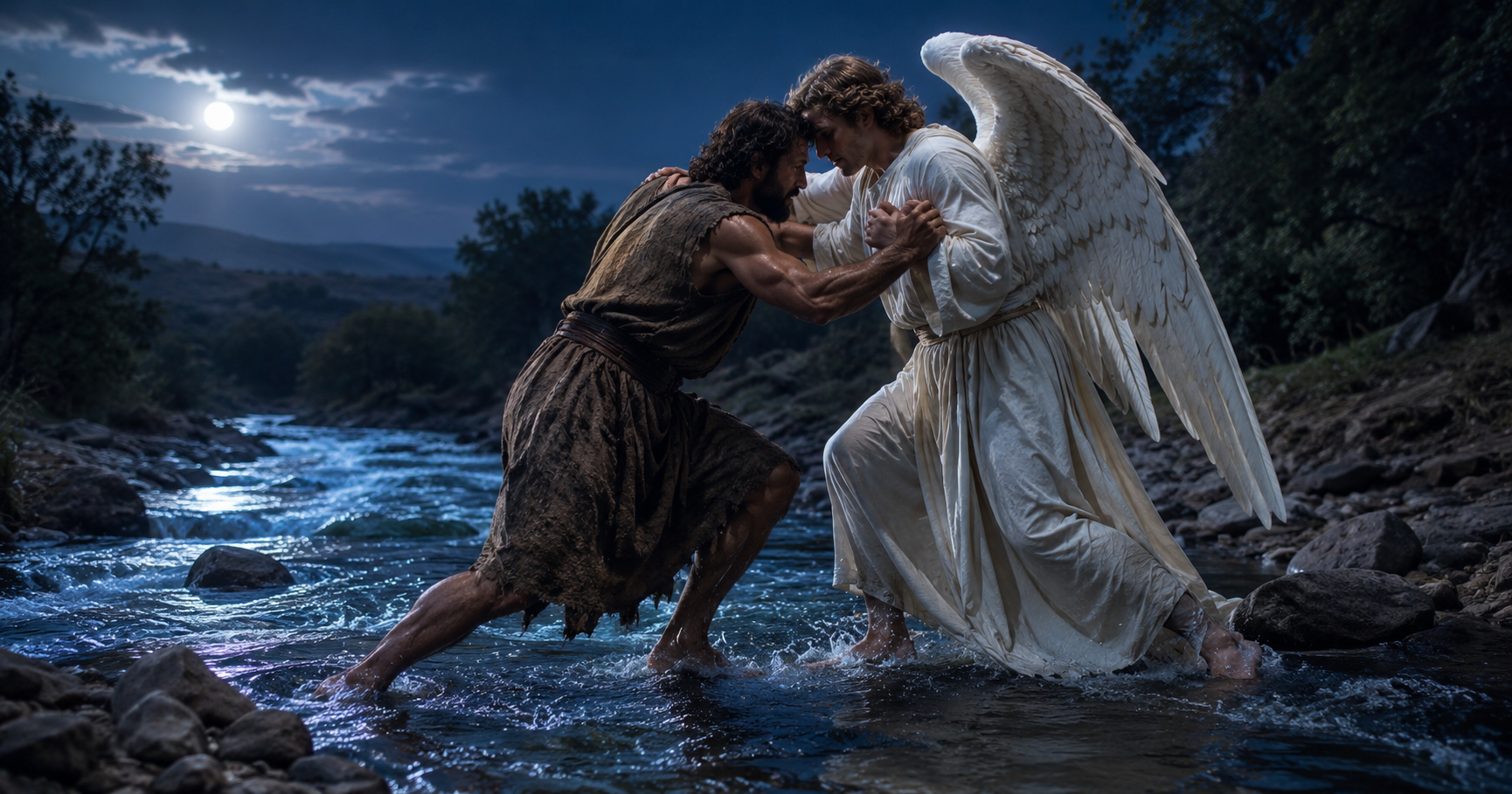
Wrestling With an Angel
SERMON PREACHED AUGUST 2, 2026 – ZION EPISCOPAL CHURCH, WASHINGTON
TENTH SUNDAY AFTER PENTECOST
GENESIS 32:22-31; PSALM 17:1-7,16
From the Psalm: I call upon you, O God, for you will answer me; *
incline your ear to me and hear my words.
When Jacob wrestled with a mysterious person at the ford of the Jabbok stream, he was at a turning point in his life. For twenty years he had been in exile, after cheating his brother Esau out of his blessing.
Remember, Esau and Jacob were fraternal twins of Isaac and Rebecca. Isaac loved Esau because he was a hunter, but Rebecca loved Jacob. One day when they were young men, Esau had been out hunting and comes home famished. He finds his brother, eating lentil stew. Esau begs for a portion, and says he will sell his birthright to his younger brother for “a mess of pottage.” The birthright of a firstborn son was significant, including a double inheritance, so this was shocking.
All was in order for Jacob as the new firstborn son, but it remained for Jacob to receive the blessing of his dying father. This wasn’t covered by the agreement between Jacob and Esau. So, Jacob conspires with his mother to impersonate his brother. Isaac, who can no longer see, thought he was blessing Esau, who had covered his arms with sheep skin to imitate his more hirsute brother. As the result, Isaac gives Jacob his deathbed blessing.
Far from being just words of good will, Isaac’s blessing is a prophetic act. It expresses faith in the promises of God, set forth in the Abrahamic covenant. At the same time it confers divine favor on Jacob. In this way, Jacob obtains the blessing that belonged to his brother. By the time Jacob is at the Jabbok crossing, he has been wrestling all his life: with Esau in the womb to be born first, for his birthright, for his father’s blessing, with Laban over wives and livestock.
And now, Jacob expects to meet the battle of his life, with Esau’s men arrayed against him. Jacob has divided his family and people into two groups, and sent each one ahead in a different direction. In this way, if one group is overtaken, the other may survive. The day ahead may prove to be the most dangerous of his life.
And now he is beset by a mysterious figure at the streamside. Who is this figure? Some say it is an angel, some say it is God. They wrestle mightily and alone.
Has this ever happened to you? Wrestling with God? Have you ever been led in one direction by the Holy Spirit, but resisted and wrestled because of what that direction will mean for your life – the things you must give up, the cost in relations with family and friends? The cost in terms of restructuring your life? The cost in terms of facing fears? The thin ice you expect to be skating on because of such a decision?
I have wrestled with God on several occasions, the most weighty being my call to priesthood. God started bothering me with this idea, and I said no. I had three good reasons to say no: First, I was Episcopalian and had never read the Bible!
Second, I was shy and avoided public speaking and leadership. I mean this seriously. At this time, my parish was preparing for the Christmas pageant. I had two little girls – a three-year-old and a four-year-old. They were to be angels in the heavenly chorus. A mother came over and asked if I would please rehearse the little ones in their one line: “Glory to God in the highest, and peace on earth goodwill to all.” This was too overwhelming for me, and I said sorry, no.
I was this shy, so I couldn’t possibly be a priest, because who would follow me?
The third reason is that it would mean the end of my marriage. When our church began ordaining women, I told my husband that someday I might like to study for the priesthood. His instant response: the day you do that is the day we will get divorced. This did happen, and my little girls suffered the result.
Then I tried bargaining with God: I tried becoming the vestry clerk. I tried running for the vestry, but was not elected. I tried running the stewardship campaign. But nothing stopped the wrestling until, that is, I finally said yes. That was my Jabbok crossing.
I recount my wrestling match not to raise up my own struggle with God, but to provide an example of how deep such wrestling can be, how life-changing. And how persistent and patient God is in guiding each one of God’s beloved people. Jacob insisted that he would not stop the struggle until the mysterious individual blessed him. That was Jacob speaking to himself, that his life was on the threshold of mighty change, guided by God, and that he would not stop the struggle until finally he would let God bless him.
When we find ourselves in such a situation, prayer is our necessary and constant companion. The psalmist offers us a way to do this:
Hear my plea of innocence, O Lord;
give heed to my cry; *
Anyone who wrestles with God must search her heart and repent of any sin that is separating her from God. Then she can pray from an innocent heart:
Weigh my heart, summon me by night, *
melt me down; you will find no impurity in me.
Of course the idea of purity, of sinlessness is unachievable by human beings. What we can do, which the psalmist was unable to know, is place ourselves at the foot of the cross, at the threshold of the open tomb, on the road to Emmaus with Jesus our risen Lord. Once for all, he lifted the burden of sin and death. Of course, each day we examine our lives and pray with the Daily Office or with the Lord’s Prayer that God will forgive our trespasses and set us free to love and serve him with full hearts and without fear. With the psalmist, we pray:
I call upon you, O God, for you will answer me; *
incline your ear to me and hear my words.
Show me your marvelous loving-kindness, *
O Savior of those who take refuge at your right hand
THANKS BE TO GOD. Amen.